
Horizon proposals: give every evaluator claim an evidence trail
A persuasive sentence is not yet an evaluator-ready claim. Proposal teams should connect each material statement to the live topic, an authoritative source, a delivery owner and the section where the evidence is proved.
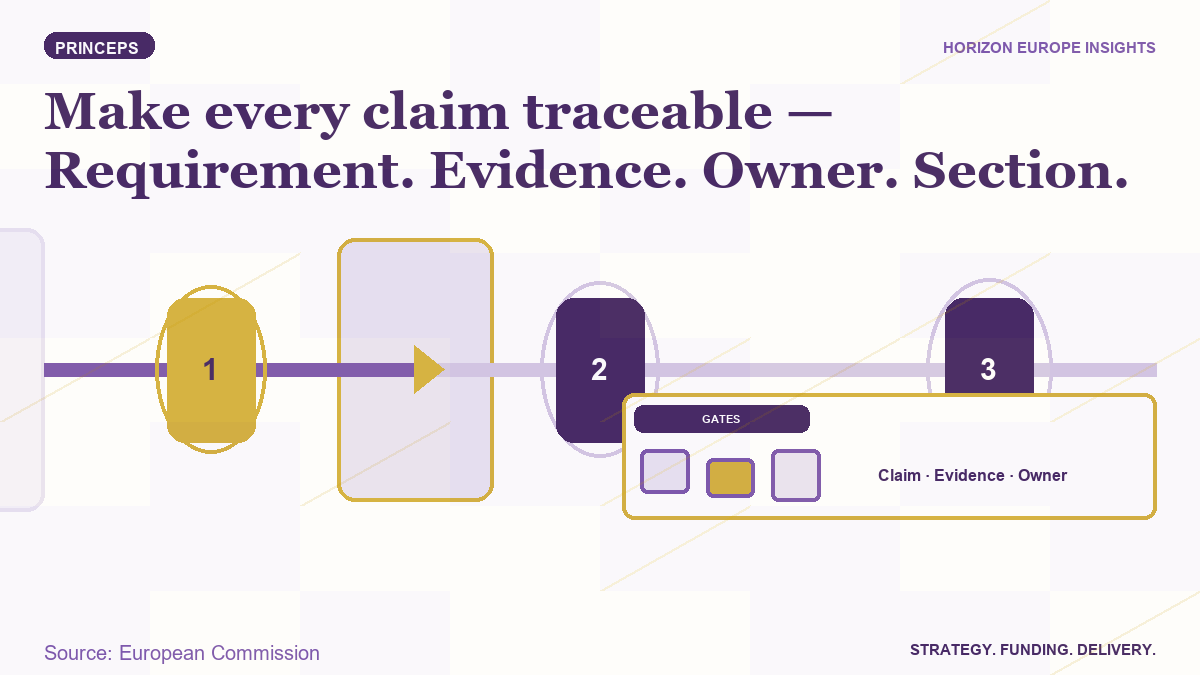
Horizon Europe proposals often fail quietly at the level of traceability. The text may sound confident, but an evaluator cannot see which topic condition it answers, which source supports the factual premise, which partner owns delivery or where the promised result is costed and tested elsewhere in the proposal.
The current full RIA/IA application form is designed around evaluator decisions. Its Excellence, Impact and Quality and efficiency of the implementation sections correspond to the main evaluation criteria. The template also states that proposals are evaluated as submitted, rather than on the basis of what they might become after significant changes. This makes internal traceability part of proposal quality, not merely document administration.
The first control is requirement traceability. Every material proposition should point back to the exact live topic wording, destination outcome, eligibility condition, action-type instruction or application-form prompt that makes the proposition necessary. Generic alignment language should not substitute for this link.
The second control is evidence traceability. A market figure, technical baseline, policy statement, readiness level, user need or impact estimate should resolve to a dated primary source, partner dataset, calculation or clearly labelled assumption. A citation at the end of a paragraph is insufficient when it is unclear which sentence the source supports.
The third control is delivery traceability. An evaluator should be able to move from an objective to the relevant tasks, partner capability, person-months, deliverables, milestones, risks and budget. If the narrative promises a capability that the implementation tables do not resource, the proposal contains an internal contradiction even when both sections read well in isolation.
PRINCEPS recommends a seven-field claim-to-evidence matrix: requirement; exact claim; evidence and date; confidence or assumption status; responsible partner; proposal location; and cross-document dependencies. Each row should also carry a final disposition: retain, qualify, replace, verify or remove.
The matrix should include quantitative claims and important qualitative claims. Statements such as 'first of its kind', 'high demand', 'scalable', 'policy ready', 'inclusive' or 'commercially viable' can be more dangerous than an incorrect number because their evidence boundary is often invisible.
Use the matrix during drafting rather than only at the end. The coordinator can assign unresolved rows to the partner best placed to supply evidence, while work-package leaders can confirm that the claim matches the planned method and resources. This avoids a late review in which polished prose must be dismantled because its foundation was never secured.
African partners should own the evidence that describes their institutions, users, operating conditions, policy environment and implementation responsibilities. A European coordinator should not infer local mandate, infrastructure, costs or adoption conditions from generic regional sources when a named partner can verify them directly.
Before submission, run a sample audit from both directions. Select ten headline claims and trace each to source and delivery. Then select ten major tasks or budget lines and trace each back to a stated objective, expected outcome or necessary control. Gaps in either direction indicate unsupported promises or unexplained expenditure.
This method does not reward citation volume. It rewards relevance and auditability. The strongest source is the one that supports the exact proposition at the correct date and scope. The strongest cross-reference is the one that enables an evaluator to understand the logic without searching across inconsistent labels.
This analysis is strategic and editorial. It does not guarantee eligibility, a score, funding or grant signature. The live topic, work programme, application form, General Annexes, submission system and competent professional or institutional advice remain controlling.
Official sources
Verify the underlying development.
- EU Grants: Application form (HE RIA and IA)European Commission · Version 5.1, 22 January 2026; accessed 24 August 2026 ↗
- EU Grants: Application form (HE CSA)European Commission · Version 5.1, 22 January 2026; accessed 24 August 2026 ↗
- Dos and don'ts when applying for fundingEuropean Research Executive Agency · Current official guidance; accessed 24 August 2026 ↗
Editorial note: This is PRINCEPS analysis for general information. It does not replace the official work programme, topic conditions, submission system, grant rules or professional advice specific to an application.