
Updated ERA AI guidance: brief your Horizon proposal reviewer
The Commission’s 16 October update sharpens the focus on AI oversight. PRINCEPS explains how coordinators can make review scope, draft provenance and verification responsibilities explicit.
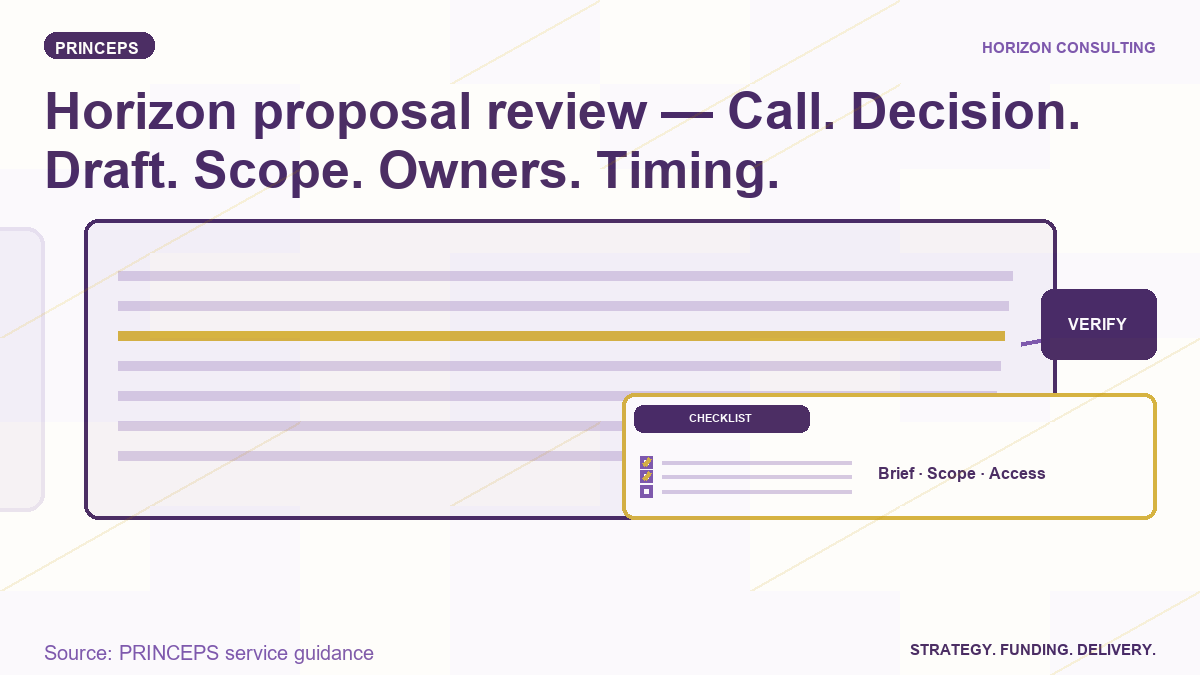
On 16 October 2026, the European Commission announced an update to the ERA Living Guidelines on the responsible use of generative AI in research. The update adds guidance on agentic AI and expands the discussion of AI in peer review and proposal evaluation. The Commission describes the guidelines as recommendations for the research community, with oversight, accountability and reliability becoming more important as tools handle more complex tasks.
This is a useful moment for Horizon Europe coordinators to revisit how they commission a proposal review. The Commission’s announcement concerns research guidance; the six-input brief below is PRINCEPS’s practical interpretation for an agreed commercial service. We do not present the checklist as a new EU application requirement or a change in eligibility. A commissioned proposal-quality review is distinct from the funder’s evaluation and should not be represented as an official assessment.
1. Call: identify the exact material and rules to review against. Provide the public topic link, call reference, application stage and deadline, with the source time zone. Identify the version of relevant instructions and any applicable institutional or funder conditions on AI use. PRINCEPS recommends agreeing this reference set first, so a review is not inadvertently based on an earlier call, a partner’s summary or an outdated template.
2. Decision: explain what the coordinator must decide. Is the immediate question whether to develop the concept, whether an integrated draft is ready for partner review, or which corrections should take priority? Name the person who can approve the scope and resolve competing comments. Define the desired feedback: a short diagnostic, section-level observations or a correction plan. Avoid asking a reviewer to check everything without agreeing the boundary.
3. Draft: describe maturity, version and relevant assistance. State which sections exist, what remains missing and whether the text is integrated or still consists of separate contributions. In the scoping conversation, identify substantial AI assistance relevant to the material and any known limitations or unverified output. This is our recommendation for useful review preparation, not a universal disclosure formula. Agree the exact version to review and identify later changes separately.
4. Scope: make the review method and exclusions explicit. Specify whether the work concerns topic fit, clarity of the intervention logic, support for claims or consistency across sections. If AI tools are proposed for any supporting task, agree whether their use is permitted, the task boundary, confidentiality conditions and who checks the output. Do not assume that commissioning a review authorises uploading proposal material to an external tool or transfers responsibility for judgement.
5. Owners: assign responsibility for verification. Identify who can substantiate technical claims, check references against original sources, confirm budget inputs and validate partner commitments. Mark provisional assumptions and missing evidence. We recommend returning unresolved factual questions to the person who holds the evidence, rather than filling gaps with plausible text. Agree how corrections will be checked and who will decide whether the final draft is ready for submission.
6. Timing and access: plan the handover. Provide the external deadline and internal decision points, and explain when a stable draft and partner inputs will be available. Start with a non-confidential outline. Share confidential material only after the engagement and secure channel are agreed. Review milestones depend on the agreed material, scope and capacity; they should leave the coordinator time to consider and implement findings.
A short written review brief can bring these six inputs together: call, decision, draft, scope, owners and timing. PRINCEPS recommends recording the output, version, exclusions and agreed handling of relevant AI use in that brief. If the draft changes materially, confirm whether the original review scope still applies. A review of one version should not quietly become assurance about a different submission.
PRINCEPS offers paid, scoped proposal review with prioritised findings, section-level observations and a practical correction plan for the agreed material. Writing revisions, portal submission and legal advice are separate scopes. To discuss a review, send a short, non-confidential introduction through our contact route with your organisation, call link, draft maturity, support needed and timing. Fees, scope and dates are agreed before work begins. Review does not guarantee eligibility, an evaluation score or funding.
Official sources
Verify the underlying development.
- ERA Living Guidelines on the responsible use of Generative AI in research updatedEuropean Commission, Directorate-General for Research and Innovation · 2026-10-16; accessed 2026-10-26 ↗
- Horizon Europe Proposal Writing & African Partner | PRINCEPSPRINCEPS GROUP EA LTD · 2026-10-26; accessed 2026-10-26 ↗
- Start a Project Conversation | PRINCEPS GROUP EAPRINCEPS GROUP EA LTD · 2026-10-26; accessed 2026-10-26 ↗
Editorial note: The review checklist is PRINCEPS service guidance. It is not an official evaluation or a guarantee of eligibility, score or funding. Scope and terms must be agreed.