
UAE market entry: separate licence, location and tax status
A UAE establishment label does not settle where a business may operate, which authority licenses it or how its tax position is treated. African firms should resolve the three status decisions before incorporation costs harden.
African companies often begin UAE market-entry planning with a binary question: mainland or free zone. That question is useful, but it is too early and too narrow. The correct route depends first on what the company will actually do, where customers and operations will sit, which competent authority licenses the activity and what permissions are needed beyond incorporation.
The UAE's official investment and economy portals present a federal investment environment, while business establishment and licensing are implemented through competent federal, emirate and free-zone authorities. The Federal Tax Authority separately maintains corporate-tax guidance and public clarifications. These official routes should be read together rather than collapsed into one sales package.
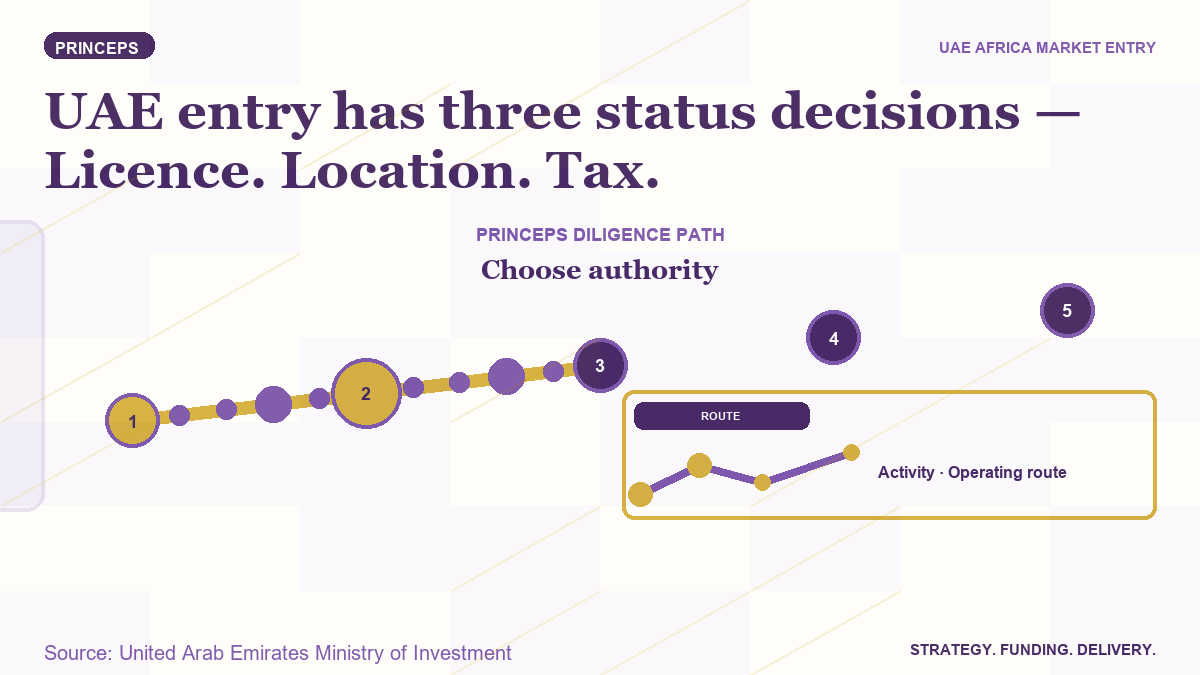
PRINCEPS recommends separating five decisions. First, define the commercial activity precisely: advisory, trading, logistics, manufacturing, technology, regulated professional service, financial service or another activity. A broad description can conceal licence categories or external approvals that materially change cost and timing.
Second, identify the licensing authority and jurisdiction. The relevant authority may depend on the emirate, mainland or free-zone location and the activity. Confirm the exact licence description, legal form, ownership route, permitted premises, renewal conditions and any approvals from a sector regulator or municipality.
Third, map the operating footprint. Ask where contracts will be signed, staff will work, stock will be held, services will be delivered, imports will clear and customers will be invoiced. An establishment certificate does not automatically answer every question about where and how the company may conduct business.
Fourth, analyse tax status as its own workstream. The Federal Tax Authority publishes corporate-tax guides, references and public clarifications. A free-zone label should not be treated as an automatic tax conclusion, and a registration step should not be confused with a final treatment of particular income, transactions or group arrangements.
Fifth, connect the structure to banking, immigration, premises, customs, data, insurance, accounting and beneficial-ownership requirements. These dependencies affect launch timing and working capital even when the incorporation itself appears straightforward.
For an Africa-UAE trading or service model, the route map should show both sides of the corridor. Identify the African operating company, exporter or service team; the UAE contracting or distribution entity; title and payment flows; customs and logistics responsibility; intellectual-property ownership; data transfers; currency exposure; and dispute-management arrangements.
Before choosing a provider or package, request a written assumptions sheet. It should name the proposed authority, activity code, legal form, shareholder structure, premises requirement, external approvals, visa allocation basis, expected government and provider fees, renewal cycle, tax-registration tasks and any conditions attached to the quoted route.
The commercial test is equally important. A structure that is legally available may still be a poor fit if customers require a different contracting route, if a bank cannot support the expected transactions, if inventory must sit elsewhere or if staffing and premises costs overwhelm early revenue.
PRINCEPS's source-based inference is that market-entry risk often comes from treating several authority decisions as one product. The practical remedy is a status map signed off by qualified UAE legal and tax advisers and confirmed against the live competent-authority portals before commitments become difficult to reverse.
This analysis is general strategic information, not UAE legal, tax, immigration, banking, customs, regulatory or investment advice. It does not guarantee licensing, an account, tax treatment, market access or commercial returns. Verify the live rules with the competent authority and qualified advisers for the exact activity and structure.
Official sources
Verify the underlying development.
- Ministry of Investment portalUnited Arab Emirates Ministry of Investment · Current official portal; accessed 24 August 2026 ↗
- Corporate Tax: guides, references and public clarificationsUnited Arab Emirates Federal Tax Authority · Current official guidance page; accessed 24 August 2026 ↗
- Business and investment informationUnited Arab Emirates Ministry of Economy and Tourism · Current official ministry portal; accessed 24 August 2026 ↗
Editorial note: This is PRINCEPS analysis for general information. It does not replace official federal, emirate, mainland, free-zone or sector rules, professional legal or tax advice, or decisions by competent UAE authorities.